Don’t forget the interest rate
Energy offers Norway enormous opportunities, but growth does not come by itself.
Geopolitics is speeding up renewable energy in countries that import energy, but not in Norway.


Text by Kjersti Boge Christensen, Communication Manager, GCE Ocean Technology.
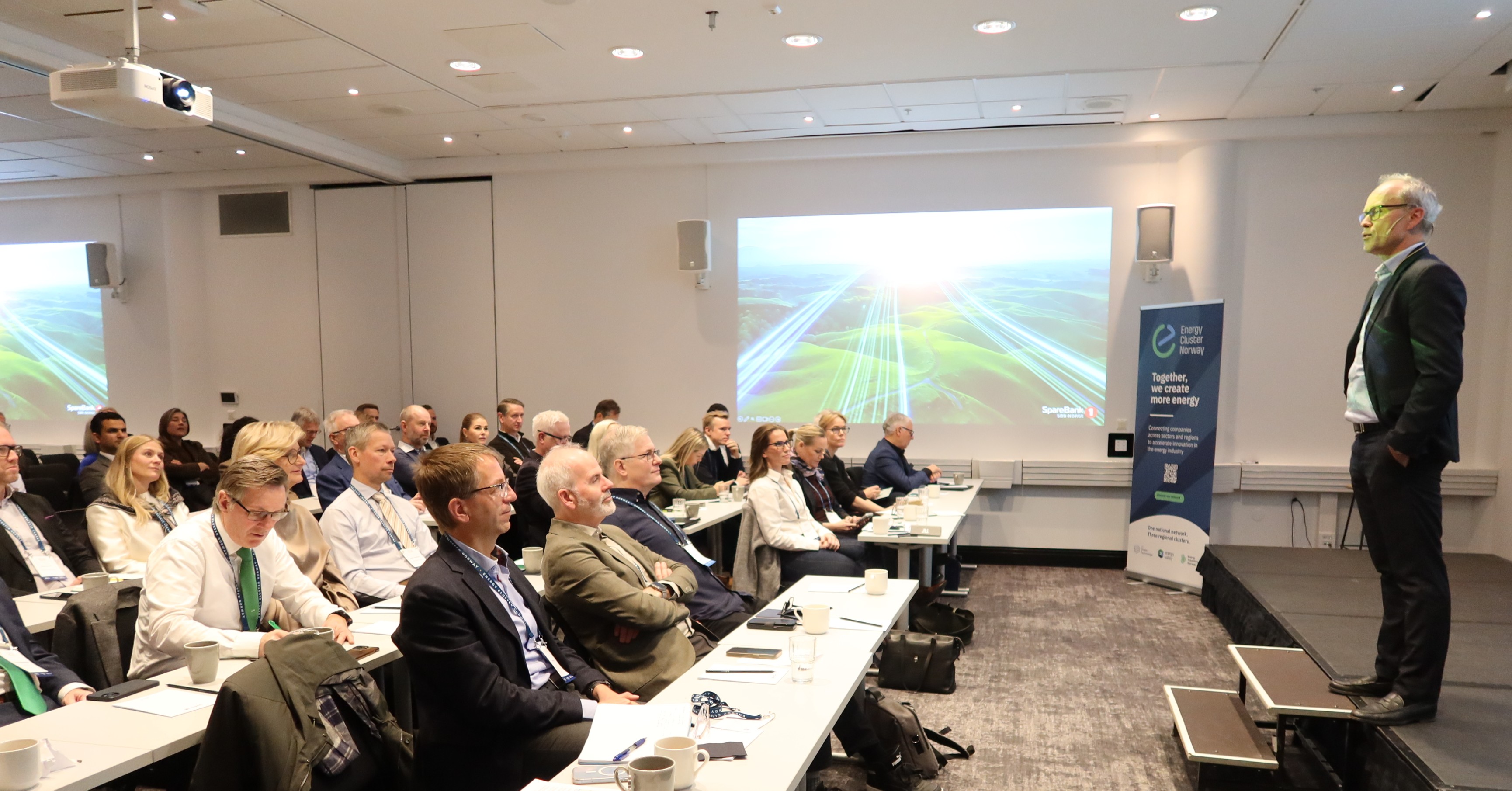
Sverre Alvik, research director for the energy transition at DNV, presented DNV’s Energy Transition Outlook 2026, and took part in the panel on how geopolitics is affecting the Norwegian energy industry.
We asked him to sum up the main points.
What are the main findings in this year’s Energy Transition Outlook?
– Recent geopolitical events have made energy security a priority, and that is pulling energy importers and exporters in different directions. Electrification is accelerating and the coming decade is about system integration, not just building more renewable generation.
National priorities and competitiveness are widening the gap between mature and emerging technologies and by 2050, the world will have reduced emissions by 44 per cent from today’s levels. That is not even halfway to net zero.
How fast is electrification going?
– The rate of electrification over the next 20 years will be double that of the previous 20 years. AI is part of that picture as electricity demand from AI is set to triple to 1,100 TWh by 2030. Data centres can be built faster than grid connections, which is pushing developers to build their own generation on site.
What will the energy mix look like?
– By 2060, solar and wind will supply 77 per cent of the world’s electricity. Coal contracts fastest, oil demand peaks around 2030 and then halves, while gas keeps the largest long-term role of the fossil fuels. Hydrogen will play a narrower role than many expected, with less than 3 per cent of global energy demand in 2060. Sectors are decarbonising, but not fast enough. Our forecast points to 2.3°C of global warming, with a risk that it ends up higher.
With energy security and oil and gas in focus, has renewable development been put on hold?
– No. There is every reason to believe that today’s geopolitical developments will, overall, lead to faster development of renewable energy. We have seen once again how vulnerable you are when you have to import energy. Europe learned that during the war in Ukraine, and now we are learning it again, not least in South East Asia. Countries then ask which energy they can produce and control themselves. That is mostly renewables, nuclear power and, in some countries, coal.
Why does this not favour oil and gas?
– Oil and gas are special, because they make up most of the energy that is exported around the world. That makes them the most exposed, and renewables are the winner.
Does this apply to Norway as well?
– There is a big difference between countries that import energy and countries that export it. In Norway, Canada or the US, this does not necessarily give renewables a boost. But it does in China, India, Germany and Spain.
Why is the Norwegian home market for renewables so weak?
– Norway is almost the only country in the world that is not building any new power between 2020 and 2030. That is quite unique, when you see how electricity production is growing in almost every other country. I think it is a combination of a lack of urgency, because Norway is not “burning” in the same way, some political developments and opposition to onshore wind, which is the cheapest form of power.
Do Norwegian suppliers need a home market to innovate?
– A home market helps, but it has turned out not to be necessary. The authorities’ ambition to cut emissions at home has been scaled back in recent years, and buying emission allowances is now seen as acceptable. That affects the supplier industry, whether in carbon capture, hydrogen or other areas. And activity on the Norwegian shelf will decline over the coming decades, so the home market of around NOK 400 billion, dominated by oil and gas, will shrink. It is the markets abroad we have to turn to.
The full Energy Transition Outlook 2026, with regional reports and sector reports on CCS, hydrogen and maritime, is available at eto.dnv.com (external site).
Fact Box
• Sverre Alvik is research director for the energy transition at DNV.
• DNV’s Energy Transition Outlook 2026 is a global and regional forecast of the energy transition to 2060.
• He presented the report at Energy Cluster Norway’s National Cluster Gathering at Gardermoen on 18 November 2026, and took part in the panel How is geopolitics affecting the Norwegian energy industry? moderated by Owe Hagesæther, CEO of GCE Ocean Technology.